
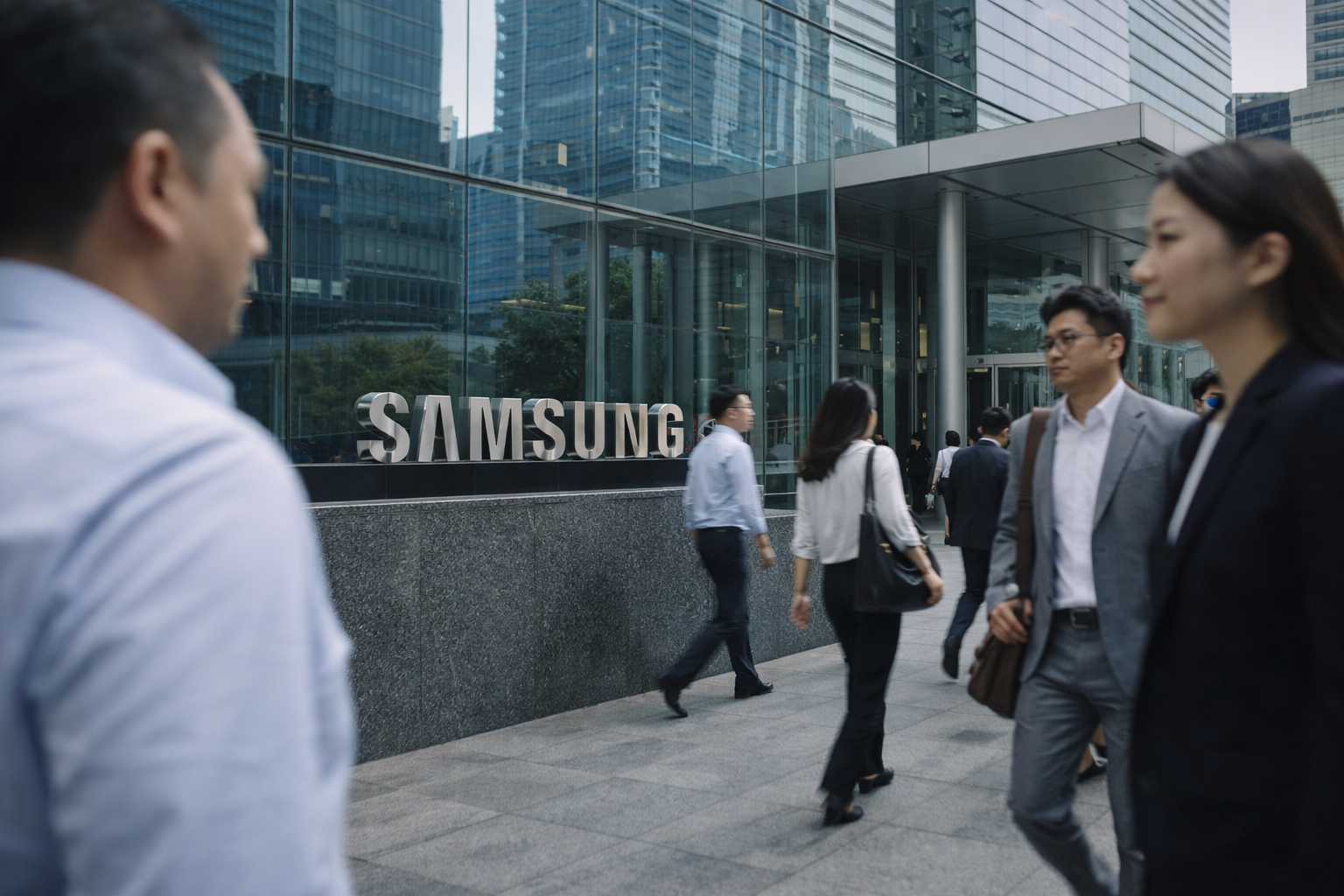
Samsung Electronics shares plunged more than 6% in Seoul on Thursday despite reporting a record quarterly operating profit of $80 billion.
The stock reversed an early gain, falling 6% to 231,500 won. Third-quarter operating profit surged 783.1% from a year earlier to 107.4 trillion won.
But the headline numbers concealed weaker consumer businesses, elevated expectations for chip earnings and a dividend announcement that offered little surprise.
Samsung Q3 earnings: Why record chip earnings disappointed investors
Revenue more than doubled to 195.3 trillion won, while operating profit exceeded the broader consensus of 105.7 trillion won. The sell-off was not an outright earnings miss.
Instead, investors focused on the gap between impressive group results and even higher expectations for semiconductors.
The Device Solutions division generated 106.5 trillion won in operating profit, below forecasts from some market participants of around 110 trillion won.
That left the group heavily dependent on memory chips. Its Device eXperience division, which includes smartphones and consumer electronics, posted an 800 billion won operating loss as higher costs squeezed profitability.
Kiwoom Securities analyst Han Ji-young said investors needed clarity on long-term chip contracts, pricing and future sales volumes.
“We need to see whether confidence in future earnings for the semiconductor sector can recover further,” Han said, according to Seoul Economic Daily’s English translation of his comments.
The reaction suggests traders are increasingly looking past today’s exceptional margins to what Samsung can earn when supply and demand eventually become more balanced.
Why dividend failed to steady Samsung stock
Samsung declared a 30 trillion won third-quarter dividend, or 4,601 won for each common and preferred share. However, much of it was already widely anticipated.
The company expects 2026 shareholder returns of 90 trillion to 110 trillion won. Of that amount, 35 trillion won has been planned or completed, leaving 55 trillion to 75 trillion won available for further dividends, buybacks and share cancellations.
Detailed decisions will come at a board meeting in late January 2027, leaving disappointed investors without an immediate answer on how much of the remaining money will reduce the share count.
“Dividends have less impact on share prices than cancellations,” Shinhan Investment & Securities analyst Kang Jin-hyeok said, according to Chosunbiz’s translated reporting.
Cancelling repurchased shares can lift earnings per share, potentially strengthening valuations. Dividends provide direct cash but do not deliver the same mechanical benefit.
The contrast with SK Hynix was striking, as its record earnings and shareholder-return measures helped propel shares nearly 11% higher on Wednesday.
Can Samsung sustain the AI memory windfall?
Samsung expects AI infrastructure investment to reach historic levels in 2027 and memory requirements to outstrip supply. The company is expanding HBM4 sales and preparing more advanced products to capture that spending.
Yet cloud companies could eventually curb data-centre investment. Higher capacity across the industry and competition from Chinese manufacturers could gradually weaken chipmakers’ pricing power.
“We think the easy money is past,” Morgan Stanley analyst Shawn Kim wrote in an note.
His warning was not that AI demand had vanished. Rather, strong future profits may already be reflected in stock prices, leaving little room for setbacks in pricing or orders.
Samsung’s planned 84.4 trillion won in capital expenditure this year underscores the scale of its investment in meeting demand. Such commitments could support growth but also raise the stakes if conditions shift.
The post Samsung stock plunges over 6% despite record $80B profit: here's why appeared first on Invezz
