
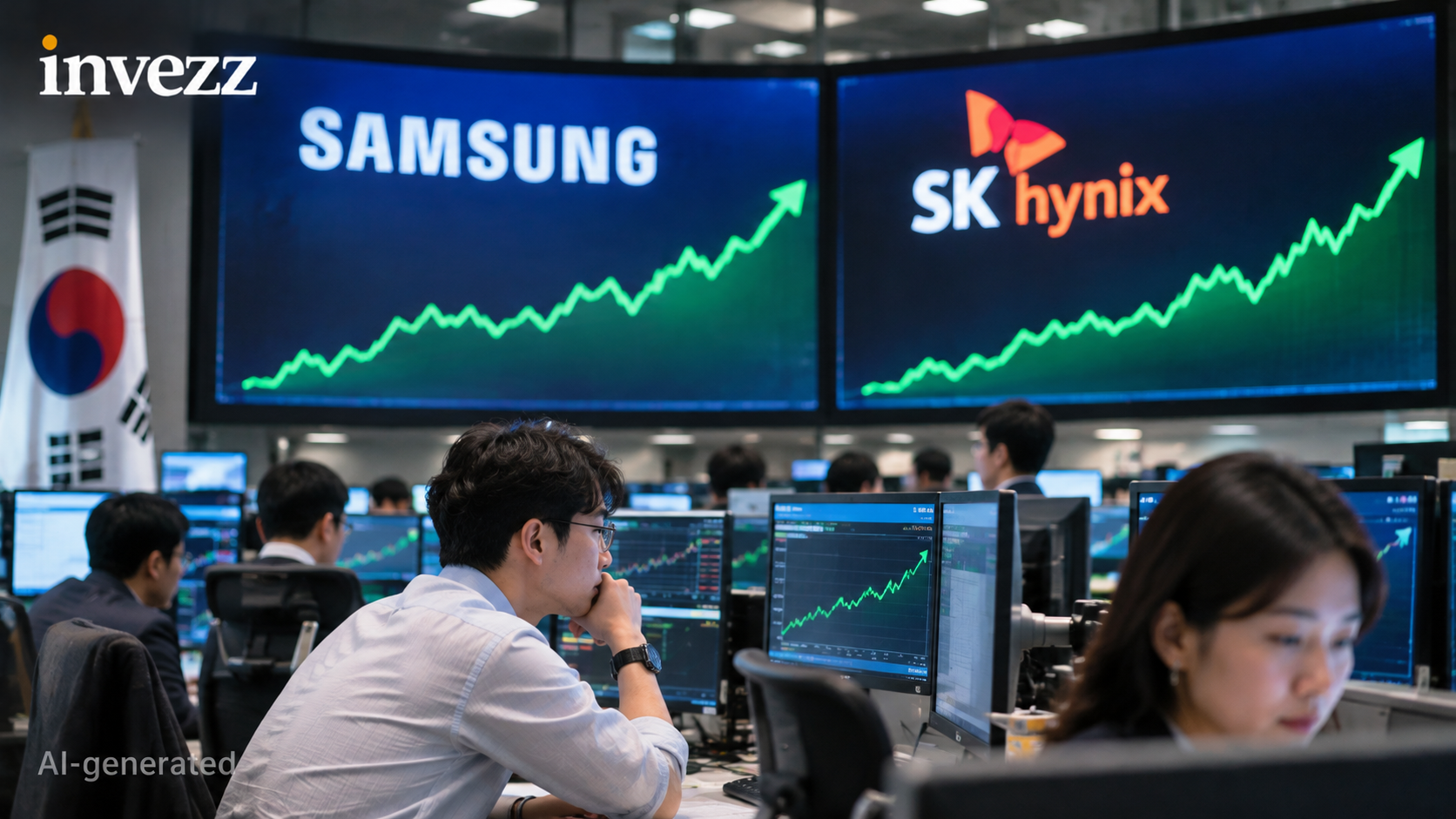
Samsung Electronics and SK Hynix stocks rebounded sharply on Monday as buyers returned to South Korean chipmakers after last week’s market rout.
Samsung gained 3.29% to 194,800 won and SK Hynix climbed 4.51% to 1,182,000 won by around 11:08 am in Seoul. The KOSPI rose 1.61% to 5,145.81, recovering from Friday’s 6.02% closing decline.
Friday’s panic briefly sent the index down more than 8%, triggering a 20-minute trading halt.
A rebound in US semiconductor shares and measures to curb forced selling have since offered limited short-term support, but investors remain cautious about future AI spending.
Samsung, SK Hynix stock today
Samsung fell 6.35%, while SK Hynix plunged 10.44%, helping push the KOSPI to its weakest close in seven months. The benchmark lost nearly 12% over the week as fears of tighter US data-centre regulation battered technology shares.
Wall Street’s Friday recovery gave investors an immediate reason to reconsider those losses. Nvidia advanced 2.78%, AMD jumped 11.04% and Micron gained 5.12%. The Philadelphia Semiconductor Index rose 4.2%, following Thursday’s 12.25% collapse.
That matters to South Korea’s largest memory producers. Demand for high-bandwidth memory and conventional server chips depends heavily on technology companies expanding AI infrastructure.
“Delays in new data center permits do not mean reduced demand for memory chips in existing servers,” Mirae Asset Securities strategist Seo Sang-young told The Herald Business. Recent chip shortages and higher prices still supported the near-term outlook, he said.
Why are Samsung and SK Hynix stocks rising despite foreign selling?
Foreign selling remains a concern. Foreign funds sold roughly 10.44 trillion won of KOSPI shares during the previous week, including about 5.42 trillion won in SK Hynix and 2.19 trillion won in Samsung.
The withdrawals continued on Monday. By late morning, foreigners had sold a net 469.3 billion won, while domestic institutions purchased 297.3 billion won and individuals bought 68.7 billion won.
The contrasting flows explain the volatility, as local buyers see cheaper shares, but overseas investors are still reducing their exposure to Korea’s concentrated semiconductor sector.
Regulators have also stepped in. From Monday, brokerage firms are temporarily exempt from a rule requiring them to maintain a 140% collateral ratio on margin loans. The three-month measure is intended to limit forced sales when falling share prices weaken borrowers’ collateral.
Yuanta Securities Korea analyst Lee Je-won said the decline reflected fears of future investment cuts and selling imbalances rather than confirmed damage to chipmakers’ businesses.
KOSPI today: Can South Korea chip stocks sustain the rebound?
Despite reclaiming 5,100, the KOSPI had dipped below 5,000 earlier Monday, demonstrating how fragile confidence remains. Kiwoom Securities expects the benchmark to trade between 4,800 and 5,350 this week.
Its forward price-to-book ratio has fallen to around 0.95, according to Kiwoom. That makes valuations look less demanding, but low multiples alone cannot guarantee a durable recovery while earnings forecasts remain uncertain.
Kiwoom analyst Han Ji-young said another succession of steep declines appeared less likely unless fresh shocks emerged.
AI disclosure: AI tools assisted with research and drafting of this piece. An Invezz editor reviewed the facts, sources and wording before publication. Any opinions or analysis are Invezz’s, not those of an automated system.
The post Why are Samsung and SK Hynix stocks surging after South Korea's market crash? appeared first on Invezz
