
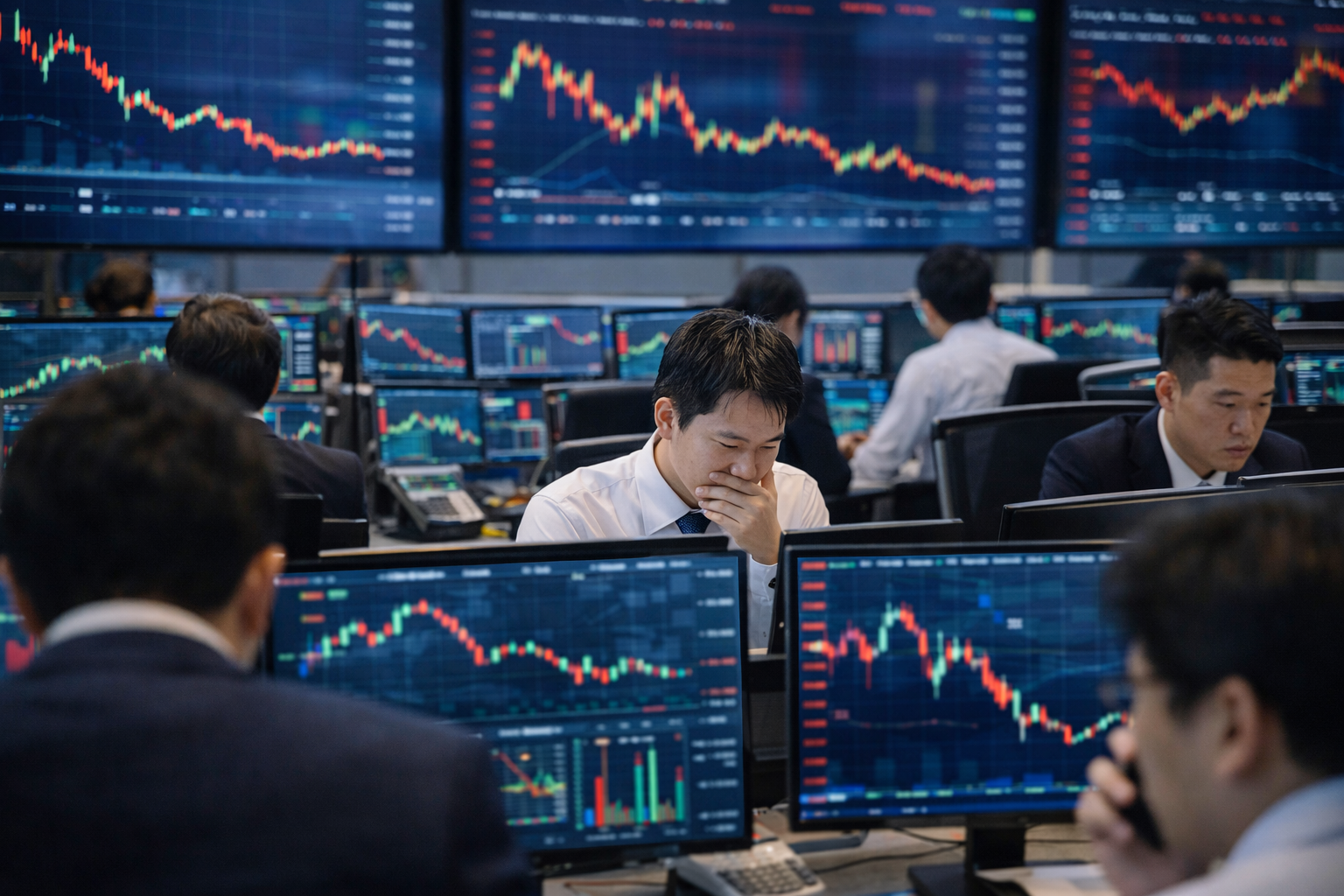
Asian stocks came under renewed pressure on Monday as another rise in oil prices and global bond yields reopened questions over how long expensive equity markets can withstand higher borrowing costs.
South Korea bore the heavier selling after returning from the Chuseok break, with the KOSPI sliding sharply as foreign investors cut exposure to semiconductor heavyweights.
Japan’s Nikkei 225 proved more resilient, trading around flat to modestly higher as chip shares and a weaker yen helped offset pressure from rising yields.
The split put two of Asia’s most technology-heavy markets at the centre of a broader test for equities as Brent crude climbed back above $106 a barrel and investors priced a greater risk of further US rate increases.
KOSPI absorbs the post-holiday catch-up trade
The KOSPI started Monday below its pre-holiday close and selling initially centred on its largest technology names.
Samsung Electronics and SK Hynix both fell more than 4% as selling intensified, putting heavy pressure on the KOSPI after the Chuseok break.
Foreign and institutional investors were both net sellers shortly after the open, while retail investors stepped in as buyers.
That matters because the KOSPI had entered the holiday with momentum. It closed at 7,080.92 on Wednesday, up 0.9%, following a rebound in AI and memory-chip shares.
Monday’s decline therefore looks partly like a catch-up adjustment to the rise in global bond yields while Seoul was closed.
Kiwoom Securities strategist Han Ji-young told MoneyToday that investors were likely to remain focused on the 7,000 level this week as US employment figures, Korean export data and Micron earnings provide the next tests for semiconductor sentiment.
Nikkei holds up as chip stocks offset yield pressure
Japan provided a different picture.
The Nikkei 225 opened higher at 66,505.94, extending its winning run, before its advance moderated.
Advantest, SoftBank Group, Disco and other semiconductor-linked names were among the early gainers, helping the index outperform Seoul.
The yen also remained weak at around 157.5 per dollar, providing some support for exporters. But Japan is hardly insulated from the rates shock.
Expectations that the Bank of Japan could tighten policy again as soon as October have added another layer of uncertainty for domestic valuations.
The contrast with Korea is notable: both markets are heavily exposed to the global semiconductor cycle, yet the KOSPI entered Monday with more holiday catch-up risk and heavier selling in its largest chipmakers.
Oil and bond yields raise Asia’s valuation hurdle
The bigger challenge sits outside either market.
Brent crude rose about 2% towards $106.50 a barrel after US President Donald Trump rejected an Iranian proposal to reopen the Strait of Hormuz, while saying discussions would continue.
The renewed rise took oil’s September gain to roughly 18%.
Markets were pricing about a 66% chance of another Federal Reserve rate increase in October, while the US 30-year Treasury yield traded near 5.52%, close to its highest since 2004.
Bank of America rates strategist Mark Cabana said in a Bank of America market update that the bond repricing reflected a major shift in expectations for the Fed, with elevated yields likely to remain a key source of volatility.
Elsewhere, the CSI 300 fell about 1.4%, while MSCI’s Asia-Pacific index outside Japan declined. S&P 500 and Nasdaq futures also traded lower, while European equity futures edged higher.
The post KOSPI leads Asia lower as 5% US yields and $106 oil hit expensive tech appeared first on Invezz
